

GEO Audit
GEO Audit: Know Exactly What AI Says About You
Run a free GEO audit. Citeme queries ChatGPT, Claude, Gemini, Perplexity & Grok via real APIs and shows exactly who gets cited, you or your competitors.
- No credit card
- Results in seconds
- 5 AI engines covered
What Is a GEO Audit?
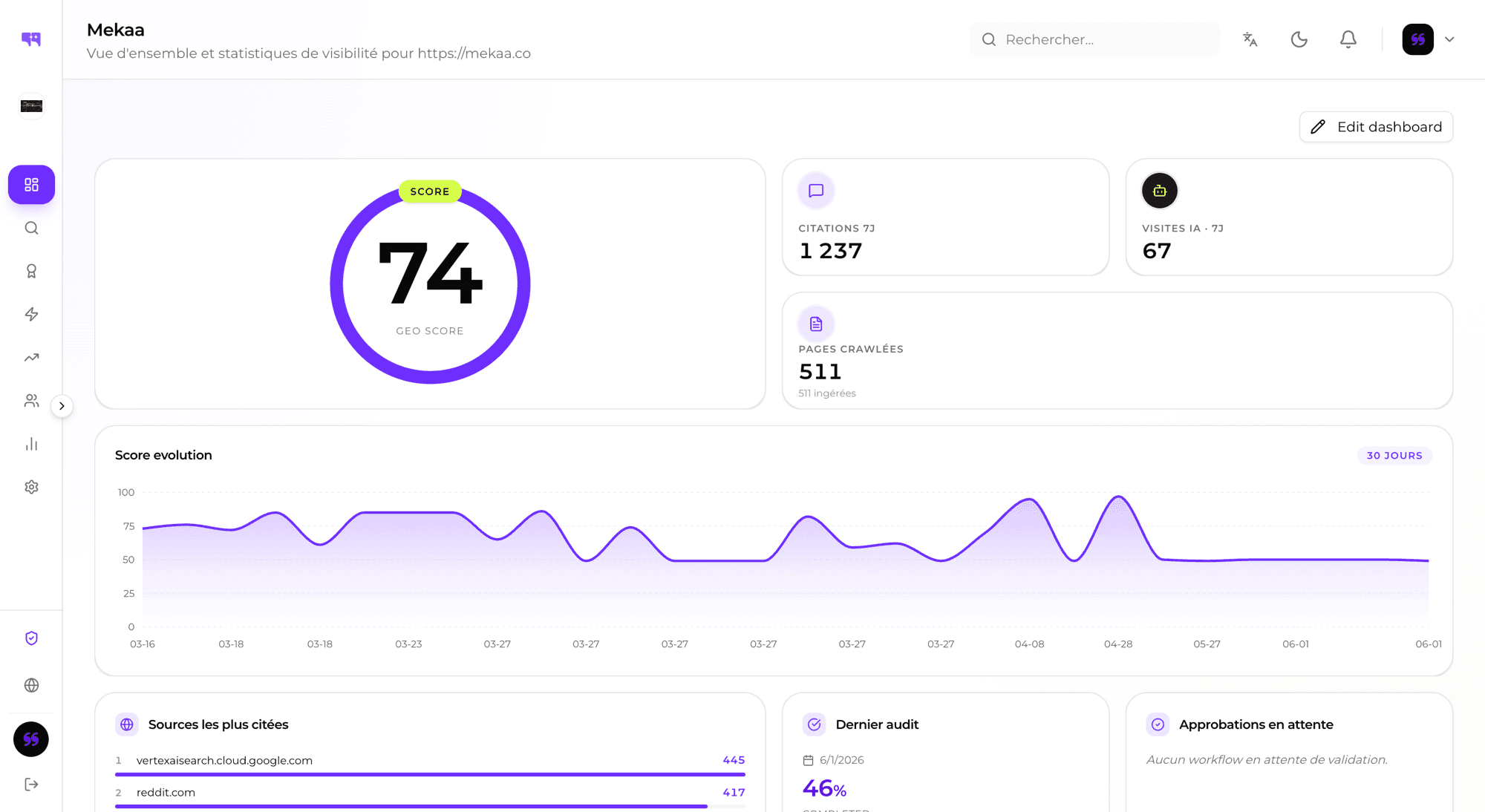
A GEO audit (generative engine optimization audit) measures how visible your website is inside AI-generated answers, ChatGPT, Claude, Gemini, Perplexity and Grok, rather than in a list of links. Unlike a classic SEO audit, an AI visibility audit checks whether the engines cite you, where you rank in their answers, and what sentiment they attach to your brand. Citeme is a free GEO audit tool that runs this analysis in minutes: paste your URL, and we do the rest.
A full diagnosis, not a vanity score
Every audit crawls your site, runs your prompts against the real engines, extracts the citations and grades 8 technical dimensions. You get the score and, crucially, the reasons behind it.
5 engines, official APIs
ChatGPT, Claude and Gemini on every plan; Perplexity and Grok on Expert. The same prompt hits all of them at once, so you compare apples to apples, in real time.
Prompts auto-generated
Citeme crawls your pages, understands your market and writes the commercial questions your prospects actually ask, from "best X for Y" to "X vs competitor".
Citation extraction
For each answer we detect whether you are cited, where in the ranking, with what confidence (high / medium / low) and what sentiment (positive / neutral / negative).
8 scored dimensions
JSON-LD, metadata, AI discoverability, HTML structure, content, semantics, web presence, security and speed. Each weighted, each explained, each with a fix.
Target by region
France, US, UK, Germany, Spain, Italy, Canada or Global. The engines answer differently per market, so you audit where your buyers actually are.
History, not snapshots
Every audit is stored. You watch citations won and lost over time and prove the impact of each change, instead of guessing from a single run.
Eight dimensions, fully transparent
Most "AI visibility" tools hand you a number and leave you in the dark. Citeme shows the full breakdown: the eight categories that make up your score, their weight, and the exact gap on each page.
AI discoverability carries the most weight (20%) because a model that cannot parse you will never cite you. JSON-LD and metadata follow, then structure, content, semantics, web presence and the technical basics.
- AI discoverability, 20%
- JSON-LD structured data, 15%
- Metadata & Open Graph, 15%
- HTML structure, 10%
- Content depth & freshness, 10%
- Semantic coherence, 10%
- Web presence & authority, 10%
- Security, speed & robots, 10%
5
AI engines queried
8
scored dimensions
2-5 min
per full audit
0-100
transparent GEO Score
How it works
- 1
Paste your URL
Crawl, sitemap detection and prompt generation are automatic.
- 2
Run the audit
The 5 engines are queried simultaneously on your prompts, in your region.
- 3
Read the verdict
Citations, sources, sentiment and the 8 dimensions, engine by engine.
Good to know
What is a GEO audit?
A GEO audit (Generative Engine Optimization audit) is a structured, data-driven evaluation of how your website is represented inside AI-generated answers, ChatGPT, Claude, Gemini, Perplexity, and Grok. Where a classic website audit checks page speed or broken links, a GEO audit answers a fundamentally different question: when a potential customer types a question into an AI engine, does it cite your brand, your content, or your competitors'? Citeme generates the commercial queries your target market actually types into AI engines, then fires them at the real APIs, no simulation, no scraping. It measures citation frequency (how often you appear), citation position (primary source, supporting mention, or absent), sentiment (positive, neutral, or negative language attached to your brand), and the technical conditions that affect AI readability: structured data, metadata, HTML semantics, page speed, and accessibility to AI crawlers. The result is a GEO Score from 0 to 100, broken down across 8 weighted dimensions. You see exactly which dimensions hold you back, which competitors are capturing the citations you should be getting, and a prioritized list of fixes ranked by expected impact.
How is a GEO audit different from an SEO audit?
An SEO audit and a GEO audit are both diagnostic tools, but they measure completely different search ecosystems. An SEO audit targets Google’s ranking algorithm: crawlability, indexability, Core Web Vitals, backlink profiles, and keyword density. A GEO audit targets AI language models: whether engines can parse your content, whether your facts are grounded and citable, whether your authority signals are machine-readable, and whether the tone of your pages makes you a trustworthy source inside AI-generated responses. The two disciplines are complementary. Strong SEO hygiene, fast pages, clean HTML, proper canonicals, improves your GEO baseline. But many sites with perfect SEO scores are invisible in AI answers because they lack structured data, factual depth, or the semantic authority signals that LLMs weigh. Running both audits in parallel gives you the full picture of your search presence.
| SEO audit | GEO audit | |
|---|---|---|
| Target | Google rankings | AI citation visibility |
| Measures | Crawlability, backlinks, Core Web Vitals | Citation frequency, relevance, authority |
| Engines | Google (+ Bing) | ChatGPT, Claude, Gemini, Perplexity, Grok |
| Output | Technical fixes list | GEO Score + dimension breakdown |
| Cadence | Quarterly / after deploys | Every 4–6 weeks or after content updates |
Which AI engines does Citeme audit?
Citeme queries five major AI engines via their official APIs: ChatGPT (OpenAI), Claude (Anthropic), Gemini (Google), Perplexity AI, and Grok (xAI). Each engine retrieves information differently, and that difference matters for your strategy. ChatGPT and Claude are primarily language models that draw on training data, with some live web retrieval in recent versions. Perplexity functions as an AI search engine that actively fetches and cites live web pages in every answer. Gemini blends both approaches, while Grok operates within X’s data ecosystem and draws on real-time posts alongside indexed content. The same website can have strong visibility on Perplexity, which indexes the live web, while being nearly absent from ChatGPT, which leans on training patterns built months earlier. Citeme surfaces these gaps engine by engine, so your team knows exactly where to concentrate effort. All five engines are queried with prompts tailored to your actual market, not generic benchmarks. Perplexity and Grok are available on the Expert plan.
How often should I run a GEO audit?
The right cadence depends on how actively you publish and how competitive your market is. Every team should begin with a baseline audit before any optimization work, you need a starting point to measure progress against. After that, three triggers should prompt an immediate re-audit. First, after every significant content update: when you publish a pillar page, update a core product page, or restructure site navigation, re-audit within two weeks. AI engines with live retrieval like Perplexity can pick up changes quickly, and you want to confirm the impact. Second, on a regular cycle every 4–6 weeks: AI models update their training data, retrieval logic, and ranking preferences continuously. A site that was performing well six weeks ago may have slipped without any change on your end, the engine moved. Third, when a competitor makes a major move: a rival launching new content targeting your core queries is a direct trigger for an immediate comparative audit to quantify the shift. For teams managing multiple sites, Citeme’s automatic scheduled audits run weekly or daily in the background, so you’re always notified before a gap becomes a trend.
What GEO score should I aim for?
The GEO Score runs from 0 to 100 and reflects your AI citation visibility averaged across 8 dimensions and the engines you’re targeting. A score above 70 indicates solid AI visibility; below 50, your site is likely invisible or inconsistently cited across the engines. Keep in mind that target scores depend on your competitive landscape. In highly contested categories, fintech, SaaS, legal, healthcare, market leaders often sit at 85–95. A score of 72 in one of those markets may still mean you’re losing ground to more aggressive competitors. The more actionable number is the per-dimension breakdown beneath the overall score. A site at 65 overall might score 92 on metadata but only 28 on content depth and semantic coherence, meaning the problem is editorial, not technical. The audit surfaces this detail, shows the weight each gap carries on your final score, and identifies the specific pages dragging the number down. Fix those first, re-audit, and track the delta.
| Score range | AI visibility status | What to do |
|---|---|---|
| 80–100 | Strong, cited consistently across engines | Defend share, expand to new query clusters |
| 60–79 | Good, visible but with exploitable gaps | Fix weakest dimensions, monitor competitors |
| 40–59 | Moderate, partial or inconsistent citations | Content depth + structured data overhaul |
| 20–39 | Low, rarely cited, low authority | Full editorial + technical GEO strategy |
| 0–19 | Invisible, not cited by any engine | Start from scratch: crawlability, schema, content |
What are the 8 dimensions Citeme measures in a GEO audit?
Every GEO audit scores your site across 8 dimensions that AI engines use, directly or indirectly, to decide whether to cite you. Each is weighted by its observed impact on citation frequency. AI discoverability (20%) is the heaviest dimension. It checks whether AI crawlers, GPTBot (OpenAI), ClaudeBot (Anthropic), PerplexityBot, and Google-Extended, can actually access your pages. A blocked crawler means zero citations regardless of content quality. Many sites unknowingly block these bots via legacy robots.txt rules. JSON-LD structured data (15%) provides the machine-readable context that helps models understand who you are, what you sell, and why you’re authoritative. FAQPage, Article, Organization, and Product schemas carry the most weight for GEO. Metadata & Open Graph (15%) covers title tags, meta descriptions, og:title, og:description, and Twitter card markup, the first signals a language model reads to assess relevance. HTML structure (10%) evaluates heading hierarchy (H1–H6), semantic landmark elements, and logical content flow. A well-structured page is easier for a model to parse and summarize accurately. Content depth & freshness (10%) assesses factual grounding, paragraph length, the presence of direct answers to questions, and how recently content was updated. Models prefer pages that answer questions completely. Semantic coherence (10%) measures how consistently your content uses the vocabulary of your market, entity coverage, synonym range, and topical authority signals. Web presence & authority (10%) considers inbound links, brand mentions, Wikipedia coverage, and external authority signals that feed AI training data. Security, speed & robots (10%) covers HTTPS enforcement, Core Web Vitals, and sitemap and robots.txt configuration, the technical baseline every page must clear.
What should I do after my GEO audit results?
Your audit delivers a ranked action list, start with the highest-impact items, not the ones that feel most familiar. The fastest wins are almost always in the top three dimensions: AI discoverability, JSON-LD structured data, and metadata. If any AI crawlers are blocked in your robots.txt, GPTBot and ClaudeBot are the most common offenders, unblocking them is the first move. Nothing else matters until the engines can read your pages. Once crawlability is confirmed, adding or enriching JSON-LD schema and sharpening title tags typically delivers the most immediate score lift. Content fixes are slower to propagate but more durable. Pages flagged for low content depth need substantive rewrites, more facts, direct answers, data tables, and expert quotes, not just more words. FAQ sections on product pages are particularly effective because they match the question format AI engines query with. Citeme’s Actions feature automates many of these changes: you review and approve, the AI agent writes and publishes directly to your CMS. After each round of fixes, re-run the audit to confirm the delta before moving to the next priority batch.
Can I compare my GEO score to competitors?
Yes, every Citeme audit runs on shared prompts, meaning your competitors appear in the same AI responses you do. The audit captures their citations alongside yours and surfaces three competitive views. The GEO Podium shows which brand ranks first most consistently across your full query set. Share of Model shows each player’s percentage share of all citations across the engines and prompts audited. The dimension breakdown lets you compare your structured data or content depth score directly against a competitor’s, pinpointing exactly where they outperform you and by how much. This makes it immediately visible if a rival is winning on Perplexity but absent on Claude, a strong signal about the type of content driving their citations and where you can counter most efficiently. On Expert plans, you can also run direct competitor audits: input a competitor’s URL and audit it exactly as you would your own site, surfacing the specific technical and content gaps that explain their AI visibility advantage.
All features
See it on your own market
Run your first GEO audit for free: your prompts, your competitors, real AI answers.